Most stalled builds don’t fail overnight — they slide. Here’s how to read the early signals of a failing software project, and the concrete moves that pull one back from the edge.
If your gut says something’s wrong with your app build, you’re usually right. A failing software project rarely announces itself — it shows up as a missed demo here, a vague status update there, a budget that keeps creeping while nothing ships.
The good news: caught early, most troubled projects can be stabilised without throwing away the work already done. Below are the seven signs we see most often when founders come to us for a rescue — and what to do about each.
How do I know if my app project is failing? Watch for slipping deadlines, no demonstrable progress, bugs outpacing features, runaway scope, broken communication, developer turnover, and rising costs with nothing shippable. One sign is a wobble; three or more at once means the project is in trouble and needs a structured rescue, not more hope.
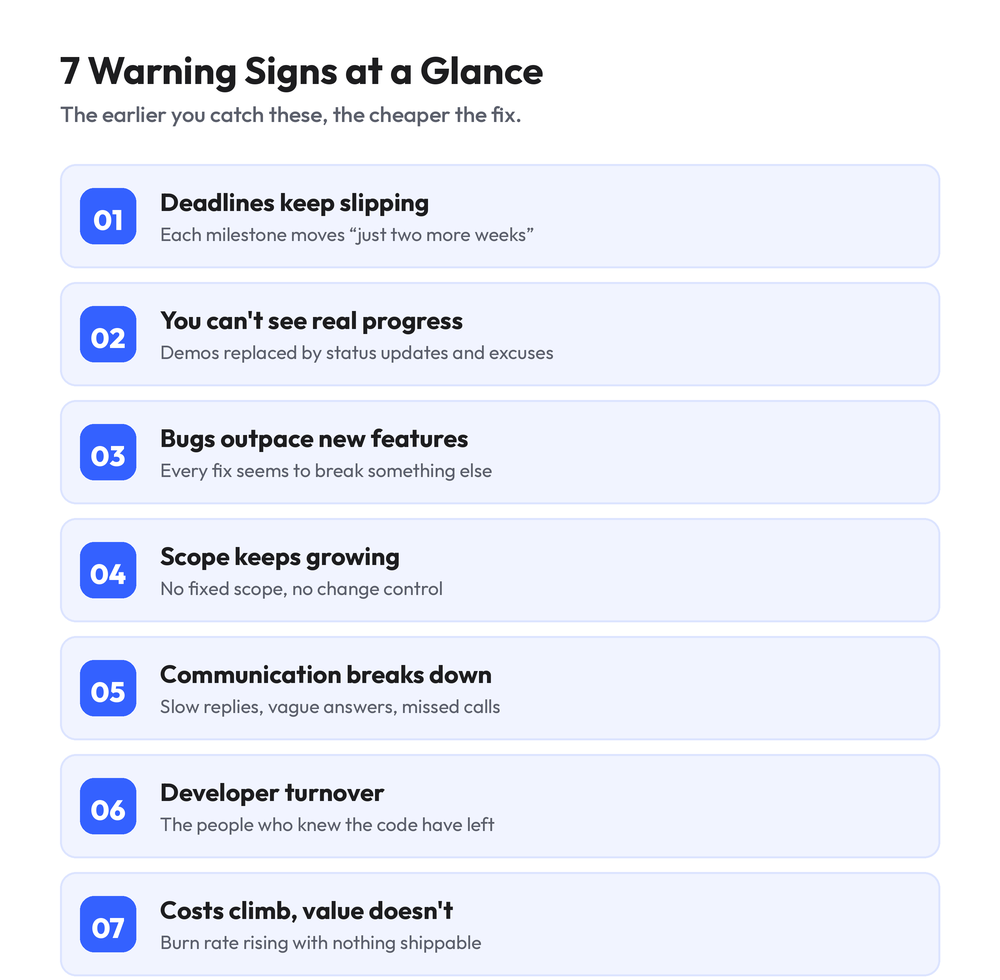
1. Deadlines keep slipping by “just two more weeks”
One delay is normal. A pattern of delays — where every milestone quietly moves and the finish line never gets closer — is the clearest early sign of stalled app development.
What it usually means:
- Estimates were never grounded in a real, fixed scope.
- Hidden technical debt is slowing every new task down.
- The team is firefighting instead of building.
The fix: stop adding features and demand a re-baselined plan tied to a fixed scope. If the team can’t produce one, that’s your answer.
2. You can’t actually see progress
Healthy projects show you working software on a regular cadence. When live demos get replaced by status decks, screenshots, and “it’s mostly done in the backend,” you’ve lost visibility — and lost visibility is where budgets quietly disappear.
The fix: require a working demo every one to two weeks, on a real device. No demo, no sign-off, no further payment.
3. Bugs are outpacing new features
If every fix seems to break two other things, the codebase is carrying serious technical debt. This is one of the strongest signs of a failing project: the team is running hard just to stay in place.
The fix: a focused code audit and architecture review to find out whether the foundation is sound or whether the debt has compounded past the point of patching.
Seeing two or three of these already?A technical audit tells you exactly how deep the problem goes — before you spend another dollar.
4. Scope keeps growing and nobody’s tracking it
Scope creep is the single most common reason app projects stall. Each “small addition” carries design, build, testing, and maintenance cost — and without change control, they pile up invisibly until the timeline collapses.
The fix: freeze the scope to a core MVP, write down what’s in and what’s out, and route every new request through a simple change-control step. If you’re earlier in the journey, our guide to app development in Canada breaks down how scope drives cost and timeline.
5. Communication has broken down
Slow replies, vague answers, missed calls, and defensiveness when you ask hard questions. In most rescues we run, the underlying problem isn’t the code at all — it’s vendor problems and a collapse in stakeholder confidence.
The fix: re-establish a fixed reporting rhythm — a weekly written update plus a live demo. Clarity returns fast once it’s structural, not optional.
6. The people who knew the code have left
Developer turnover mid-project is dangerous because knowledge walks out the door with the people. The remaining team inherits code they didn’t write and can’t fully explain, and your delivery pipeline grinds down.
The fix: insist on documentation, a clean handover, and a code audit so a new team can pick up the work without starting from zero.
7. Costs climb but value doesn’t
The most painful sign: your burn rate keeps rising while nothing shippable appears. Money is going in; a working product is not coming out.
The fix: stop, get an independent assessment, and re-anchor every remaining dollar to a shippable outcome — not to hours billed.
The 7 signs and their fixes, at a glance
| Warning sign | What it signals | First move |
|---|---|---|
| Slipping deadlines | No fixed scope / technical debt | Re-baseline the plan |
| No visible progress | Lost delivery visibility | Demand working demos |
| Bugs > features | Compounding technical debt | Code & architecture audit |
| Runaway scope | No change control | MVP scope reduction |
| Broken communication | Vendor problems | Fixed reporting rhythm |
| Developer turnover | Knowledge loss | Documentation & handover |
| Costs up, value flat | Rising burn rate | Independent assessment |
My development agency keeps missing deadlines — what do I do? First, stop adding scope. Then ask for a re-baselined plan tied to a fixed scope and a working demo within two weeks. If they can’t deliver either, get an independent code audit before paying more. Missed deadlines plus no demonstrable progress is the point to bring in a rescue team.
Can a failing project be saved without starting over?
Usually, yes. The instinct to scrap everything and rebuild is often the most expensive choice you can make. The real question is whether the foundation is sound — and that’s a decision you make with evidence from an audit, not panic.
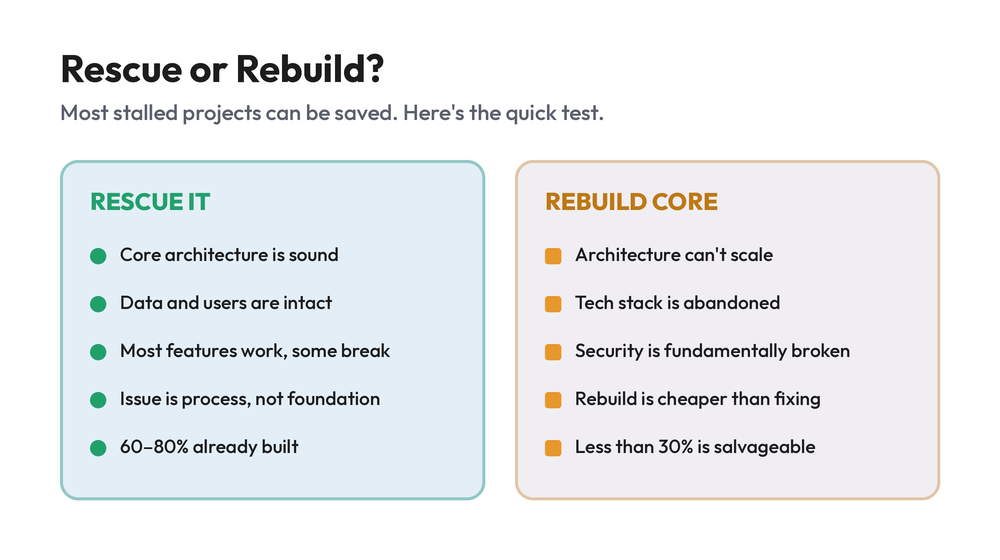
Can a failing software project be saved without starting over? In most cases, yes. If the core architecture is sound, the data and users are intact, and 60–80% is already built, the right path is stabilisation — a code audit, MVP scope reduction, and a re-baselined plan — not a rebuild. Full rebuilds only make sense when the architecture can’t scale or less than 30% is salvageable.
What a structured software project rescue looks like
A real software project rescue isn’t “more developers, faster.” It’s a sequence:
- Audit — a code audit and architecture review to find the true state of the build.
- Stabilisation — stop the bleeding: fix the critical breakages, restore the delivery pipeline.
- MVP scope reduction — cut back to a shippable core so you can launch and rebuild confidence.
- Rescue plan — a re-baselined roadmap with realistic dates and a fixed scope.
If you recognise these signs, our project rescue service starts with exactly this kind of technical audit — and if you’d rather start clean, we also build and design MVPs from scratch on a fixed scope, fixed price model.
We build, fix, and scale digital products
Build Me App is a Toronto product studio that has shipped 20+ products across fintech, healthtech, SaaS, eCommerce, edtech, and more — each a real client, a real launch, a real result. Rescuing projects that went off track with another vendor is one of our six core services, sold and stood behind on its own.
Frequently asked questions
Look for slipping deadlines, no demonstrable progress, bugs outpacing features, runaway scope, broken communication, developer turnover, and rising costs with nothing shippable. One sign is a wobble; three or more together means it’s failing and needs a structured rescue.
The seven most common: repeated missed deadlines, lack of visible progress, bugs growing faster than features, uncontrolled scope creep, communication breakdown, developer turnover, and a rising burn rate without a shippable product.
Stop adding scope, ask for a re-baselined plan tied to a fixed scope, and require a working demo within two weeks. If they can’t deliver either, get an independent code audit before paying more.
Usually, yes. If the architecture is sound and most of the build is intact, stabilisation plus MVP scope reduction is faster and cheaper than a rebuild. Full rebuilds only make sense when the foundation can’t scale or little is salvageable.
Build Me App is a Toronto-based product studio specialising in building, fixing, and scaling digital products for startups and businesses across North America. Related reading: App development in Canada and MVP design & build.