A range without context is useless. Here’s how MVP development cost actually breaks down in 2026 — the real tiers, what moves the number, and a live fintech build to anchor it.
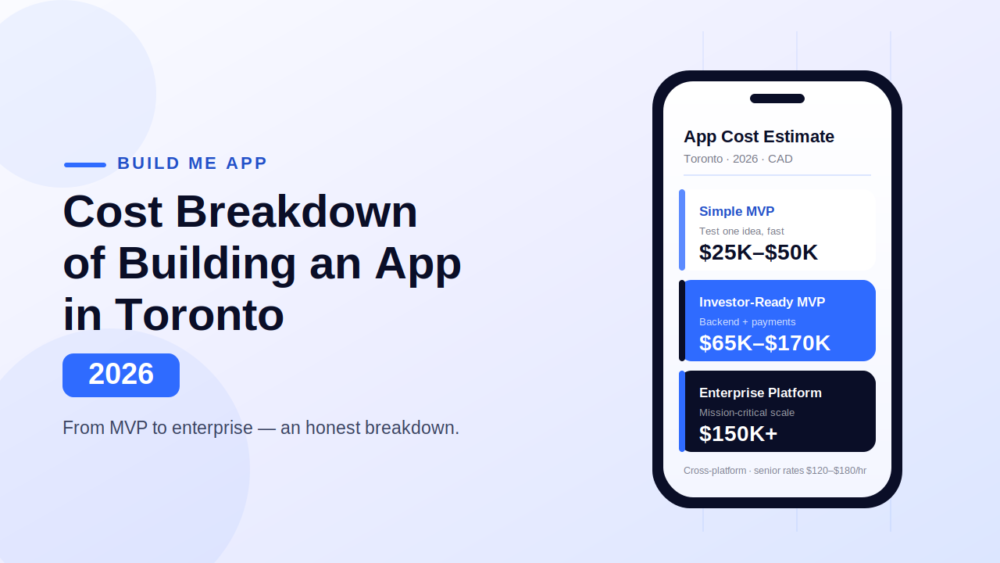
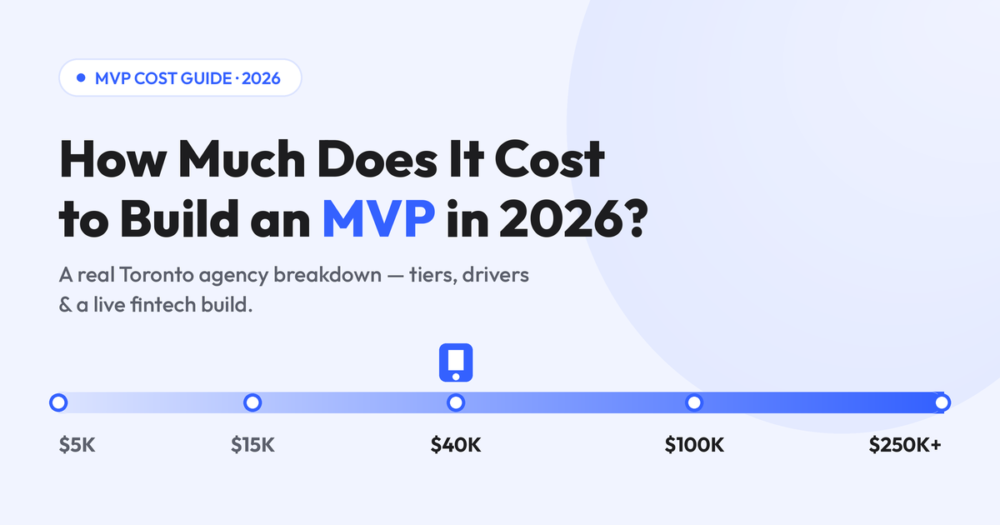
If you’ve collected three quotes to build the same app and they came back at $18,000, $55,000, and $140,000, you’re not doing anything wrong — that spread is normal. MVP development cost in Canada 2026 genuinely ranges from about $15,000 to $250,000+, and the reason the same idea can land anywhere on that line has almost nothing to do with the idea itself.
It comes down to four decisions: how many features you actually ship, how the product is designed and built, which tech stack it runs on, and who builds it. Founders who understand the cost to build an MVP in Canada before they start are the ones who control their burn rate instead of being surprised by it. This is the breakdown we give Toronto founders before we quote a single dollar.
How much does it cost to build an MVP in 2026? A custom-built, investor-ready MVP typically costs between $25,000 and $100,000, takes 8–16 weeks, and covers one core user flow done properly. No-code validation can start near $5,000; AI-native or regulated builds (fintech, healthtech) push past $120,000. The number is set by feature count and complexity — not by your idea.
What an MVP actually is (and why the definition controls the price)
Before talking about MVP app development cost in Canada, it’s worth being precise — because the industry uses the term loosely, and that looseness is exactly what costs founders money.
A minimum viable product is the smallest functioning version of your product that real users can use to give you real feedback. The word doing the work is viable. It has to function. It has to solve one specific problem for one specific user well enough that they’ll engage, give feedback, and ideally pay. Anything short of that is a prototype — and prototypes are scoped and priced completely differently.
Most founders who get burned paid custom-build prices for something a no-code tool could have validated, or paid no-code prices expecting a custom result. Knowing which one you need is the single most valuable thing you can sort out before you start.
MVP cost in 2026 by build type
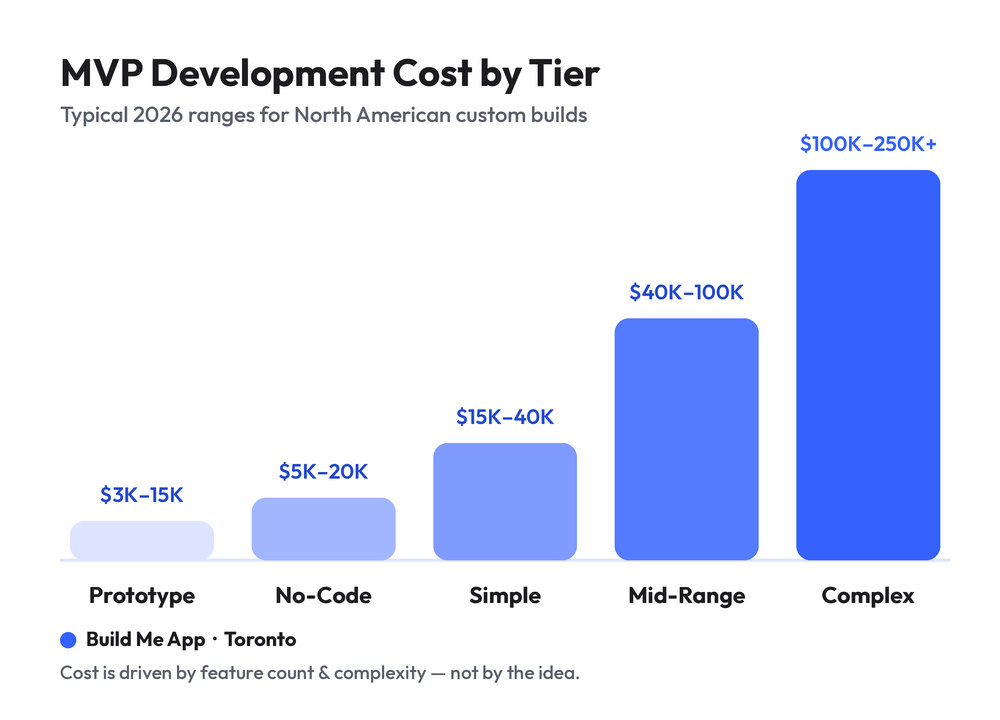
The biggest driver of minimum viable product cost isn’t your developers’ hourly rate or where they sit — it’s complexity, meaning the number and depth of features needed to test your core hypothesis. Here’s how it breaks down across the main tiers.
| MVP type | Typical cost | Timeline | Best for |
|---|---|---|---|
| Prototype / Wireframe | $3K – $15K | 1–3 weeks | Design validation only — not a shippable product |
| No-Code MVP Fastest | $5K – $20K | 2–6 weeks | Quick validation; limited scalability for growth |
| Simple MVP Recommended | $15K – $40K | 6–10 weeks | Idea validation, angel demos, pre-seed raises |
| Mid-Range MVP Most common | $40K – $100K | 10–16 weeks | Seed-stage startups, first paying customers |
| Complex MVP Enterprise | $100K – $250K+ | 16–24 weeks | Regulated, AI-native, multi-sided platforms |
Simple MVP: $15K – $40K
One primary user flow, basic authentication, a clean template-based UI, and a straightforward backend with minimal integrations. User signs up, does one core thing, gets value. Enough polish for early users or angel investors — but not advanced integrations, real-time features, or AI.
Mid-Range MVP: $40K – $100K
Where most serious startup MVPs land. Three to five user flows, payment processing, third-party API integrations, custom UI/UX (not templates), cross-platform functionality, and a backend that won’t need a full rewrite at Series A. This is the tier where your choice of development partner matters most.
Complex MVP: $100K – $250K+
Reserved for products whose core value depends on hard things: native AI features, financial compliance, real-time data at scale, or multi-sided marketplaces. If your MVP has to do something heavy on day one to prove the thesis, this is where it sits.
Not sure which tier you’re in?We’ll map your idea to a tier and a fixed number — free.
Why MVP quotes vary so much between agencies
Why do MVP quotes vary so much? Because “MVP” is undefined until someone fixes the scope. A $20K quote and a $90K quote for “the same app” are usually pricing different feature lists, different design depth, and a different tech stack. The cheap quote often omits QA, integrations, and a scalable backend — costs that reappear later as a rebuild.
The real culprits behind a wildly variable number are usually these:
- Feature prioritisation. Every “small” feature carries design, build, testing, and maintenance cost. The fastest way to halve a quote is to cut the feature list to what actually validates the hypothesis.
- Tech stack & native vs cross-platform. A cross-platform build (one codebase for iOS and Android, e.g. React Native) is usually cheaper to ship than two native apps. Web vs mobile changes the number too.
- Design depth. A template UI is a fraction of the cost of bespoke design — and for an MVP, a clean template is often the right call.
- AI features. Bolting on LLMs, classification, or automation adds real cost. Worth it when AI is the product; expensive noise when it isn’t.
- Scope creep. The silent budget-killer. Without a fixed scope, “just one more thing” repeated across a build is how a $40K project becomes $80K.
This is exactly why our MVP design and build service works on a fixed scope, fixed price model — you know the number and the timeline before we start, and scope creep becomes a deliberate decision instead of a surprise on the invoice.
Freelancer vs agency vs in-house: which is cheaper?
Is it cheaper to build an MVP with a freelancer or an agency? A freelancer has the lowest sticker price and works for a tightly-scoped single-skill task. An agency costs more upfront but bundles design, development, QA, and project management — usually faster time to market and lower total cost when the build needs more than one discipline. An in-house team is the most expensive to stand up and only makes sense once the product is validated.
The honest framing: you’re not comparing rates, you’re comparing total cost and risk to launch.
• Freelancer — cheapest line item; you become the project manager, the integrator, and the risk owner. Great for a defined piece, fragile for a whole product.
• Agency — one accountable team across design, build, and QA. Higher rate, but fewer gaps, faster time to market, and a single point of responsibility when something breaks.
• In-house — months of hiring plus salaries and overhead before a line of code ships. The right move after product-market fit, rarely before it.
What features a first MVP should include to keep costs down
What features should a first MVP include to keep costs down? Exactly one core flow that proves your hypothesis, plus the minimum around it: simple authentication, the single feature that delivers your value, and basic analytics to measure whether people use it. Defer dashboards, settings, social logins, admin panels, and “nice to have” features to version two.
A disciplined discovery phase is where this gets decided. Spending a week ruthlessly separating “must validate now” from “can wait” is the cheapest insurance against scope creep you’ll ever buy. Cut the feature list, protect the budget, get to product-market fit, then spend on the things real usage proves you need — including ongoing maintenance cost, which is real and easy to forget at quote time.
EMOH Pay: a real-world mid-range fintech MVP
EMOH Pay is a Canadian personal-budgeting app we built end-to-end — and a clean example of where the mid-range tier goes. It connects to users’ banks via the Plaid API, uses AI to auto-categorise spending, and delivers real-time net-worth insights, shipped cross-platform on React Native for iOS, Android, and web.
It’s the textbook profile of a build that lands above the simple tier: live bank integration, machine-learning categorisation, and fintech-grade data handling are the exact features that move an MVP up the cost ladder — and the exact features worth paying for when they are the product.
A realistic startup MVP budget for 2026
What’s a realistic budget for a startup MVP? For most funded early-stage startups, plan for $40,000–$100,000 and a 10–16 week timeline for a custom, investor-ready MVP. Pre-seed founders validating a single idea can land in the $15K–$40K simple tier. Always hold back roughly 15–20% of the budget for post-launch iteration — the feedback is the entire point of building an MVP.
Whatever tier you’re in, the budget protects itself the same way: fix the scope, lead with one flow, and treat every additional feature as a cost decision rather than an assumption. Get that right and the MVP cost in 2026 stops being a gamble and starts being a plan.
Get a fixed-scope MVP quote
Tell us the one thing your product has to prove. We’ll scope it, price it, and give you a fixed number and timeline — no surprises on the invoice.
Frequently asked questions
How much does it cost to build an MVP in 2026?
Between roughly $15,000 and $250,000+. A custom, investor-ready MVP usually lands at $25K–$100K over 8–16 weeks. No-code validation can start near $5K; AI-native or regulated builds run past $120K. Feature count and complexity set the number, not your idea.
Why do MVP quotes vary so much between agencies?
Because “MVP” isn’t defined until someone fixes the scope. Different quotes price different feature lists, design depth, and tech stacks. Cheaper quotes often quietly omit QA, integrations, and a scalable backend — which reappear later as a costly rebuild.
Is it cheaper to build an MVP with a freelancer or an agency?
A freelancer has the lowest sticker price and suits a single, tightly-scoped task. An agency costs more upfront but bundles design, development, QA, and project management — usually faster to launch and lower total cost when the build needs more than one skill.
What features should a first MVP include to keep costs down?
One core flow that proves your hypothesis, simple authentication, the single value-delivering feature, and basic analytics. Defer dashboards, admin panels, social logins, and extras to version two.
What’s a realistic budget for a startup MVP?
For most funded early-stage startups, $40K–$100K over 10–16 weeks for a custom MVP. Pre-seed validation can sit in the $15K–$40K range. Reserve 15–20% for post-launch iteration.