We hear this question almost every week from founders walking into their first scoping call: “Why does a mobile app development cost so much?” It’s a fair question — and the honest answer surprises people. The price isn’t a Build Me App number. It’s a market number.
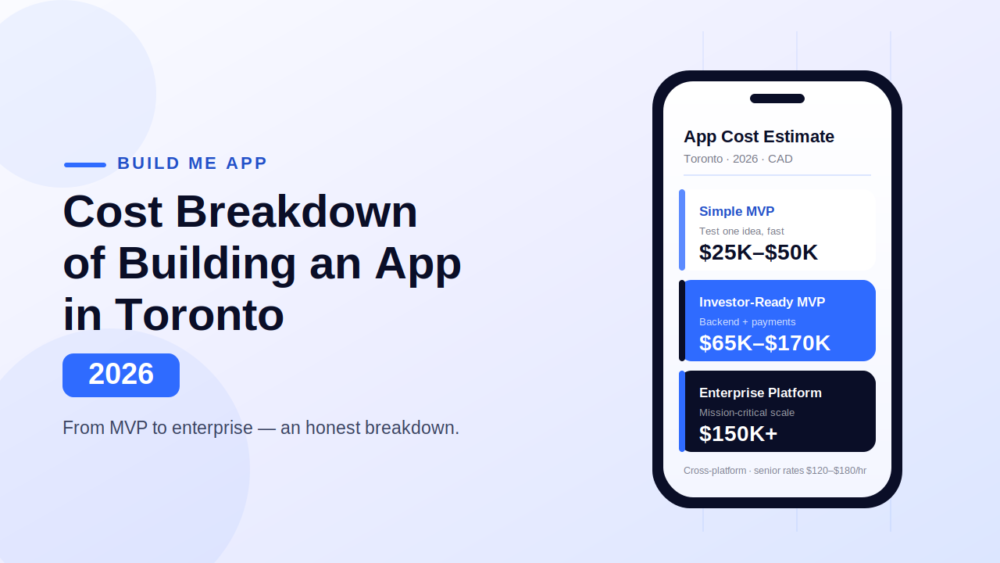
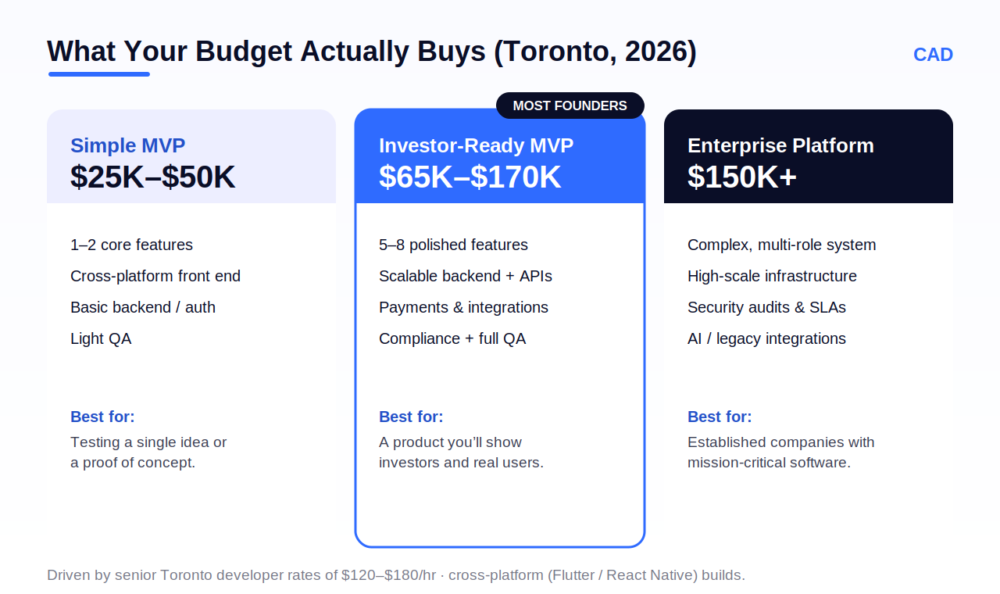
In 2026, a cross-platform mobile MVP built on Flutter or React Native by a professional Toronto studio typically costs between $65,000 and $170,000 for an investor-ready product. That range holds whether you’re talking to us or to any other reputable team in the city, because the underlying inputs — senior engineering time, backend architecture, compliance, and QA — cost roughly the same everywhere quality is taken seriously.
This guide breaks down exactly where that money goes, why AI coding tools haven’t collapsed the price the way the headlines suggest, and how to read a quote so you can tell the difference between a real estimate and a number designed to win your signature. If you’d rather skip the theory and get a transparent figure for your specific idea, you can get a free & honest quote here.
The Real Number: What a Toronto MVP Actually Costs in 2026
Let’s start with the figure no one likes to say out loud. Across Canadian and Toronto-specific market data in 2026, a basic-to-mid-complexity app or MVP generally lands in the $25,000–$80,000 CAD range, while investor-ready products with real backends, payments, and polish climb into the $95,000–$170,000+ territory. Enterprise-grade platforms routinely exceed $150,000.
The single biggest line item is people. Senior app developers in Toronto bill between $120 and $180 CAD per hour, and that rate is consistent across the city’s reputable studios — it’s a reflection of the local talent market, not a markup any one agency invented. When you multiply a professional rate by the hundreds of hours a real product takes, you arrive at the numbers above. There is no shortcut around skilled time.
| One thing to be clear about: these are market figures — the going rate across reputable Toronto studios — not Build Me App’s pricing. We don’t quote off a chart. Your number depends on what your product actually needs, and the only way to know it is to scope your idea. That’s exactly what our free quote is for — an honest estimate for your build, not a generic range. |
Where the Money Actually Goes
“The app” is the part you can see — the screens, the buttons, the smooth animations. But the screen is the tip of the iceberg. Most of the budget goes into the parts users never notice until they break.
| Cost Driver | Why It Matters |
| Discovery & Scoping | A paid discovery phase (typically 2–4 weeks) defines features, user flows, and architecture before a line of code is written. It’s the cheapest insurance against mid-project scope creep — the #1 cause of budget overrun. |
| UX/UI Design | Wireframes, prototypes, and a design system. This is where retention is won or lost — investors and users both judge a product in the first ten seconds. |
| Frontend (Flutter / React Native) | Cross-platform frameworks ship iOS and Android from one codebase, cutting frontend hours 30–45% versus separate native builds. This is the smartest cost decision most founders can make. |
| Backend & Infrastructure | APIs, databases, auth, and cloud hosting. This is the part cheap quotes quietly leave out — and the part that determines whether your app survives its first thousand users. |
| Compliance (PIPEDA & more) | Canadian apps handling personal data need PIPEDA-compliant storage, consent flows, and privacy implementation — which can add meaningful cost but is non-negotiable for any serious product. |
| QA & Testing | Testing across devices (iPhone 13 vs 15, Samsung vs Pixel) and edge cases. Skipping QA is how you ship a demo, not a product. |
| Post-Launch Maintenance | Budget 15–20% of the build cost annually to keep the app alive — OS updates, security patches, and bug fixes never stop. |
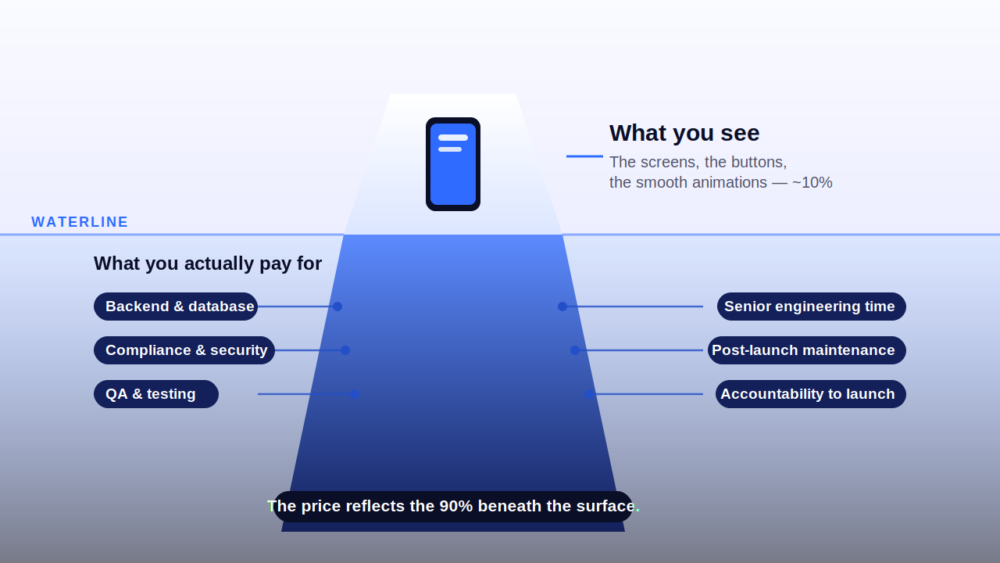
Our MVP Design & Build service is scoped around exactly this iceberg — the goal is to get the full product (not just the visible 10%) shipped in roughly 8 weeks without surprises.
“But What About AI? Doesn’t That Make Apps Cheaper Now?”
This is the most common follow-up, and it deserves an honest answer. Yes — AI coding tools like GitHub Copilot, Cursor, and Claude Code are now standard equipment. Roughly 84% of developers use or plan to use them, and they genuinely accelerate parts of the workflow.
But the savings are smaller than the marketing implies. Vendor studies love to cite 50–100% productivity gains, but those come from controlled tasks and self-selected early adopters. Independent research tells a more sober story: across real, full projects, the realistic impact lands closer to 10–25% — and one well-known controlled trial even found experienced developers were slightly slower with AI on complex tasks, despite feeling faster.
Here’s the key insight: AI speeds up writing code. It does not shrink the actual scope of building software. It doesn’t design your backend architecture, doesn’t interpret your compliance requirements, and doesn’t replace the human judgment in QA and code review. In fact, studies show a meaningful share of AI-generated code contains security weaknesses that require an experienced developer to catch. The tools got faster; the work didn’t get smaller.
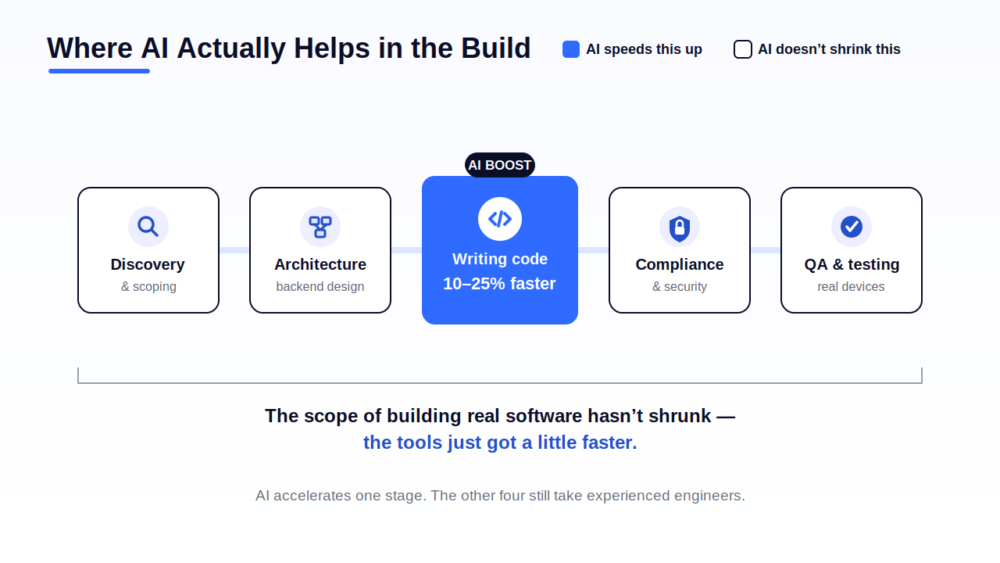
We build AI into products where it creates real value — that’s the focus of our AI Enablement & Integration service — but we’re honest about what it does and doesn’t change about the cost of building well.
What You’re Actually Paying For
Strip away the line items and a premium quote comes down to three things you can’t fake:
- Engineers who’ve shipped before. People who have already navigated app-store rejections, payment edge cases, and scaling failures — so you don’t pay to teach them on your project.
- A codebase that survives your Series A. Architecture that an investor’s technical due-diligence team can open without wincing, and that your next ten engineers can build on.
- Accountability from kickoff to launch. One team that owns the outcome — not a hand-off chain where everyone blames the previous link when something breaks.
If your current build has already gone off the rails with a cheaper provider, that’s a common story — and a fixable one. It’s exactly what our Project Rescue & Scaling service exists for.
How to Read a Quote (and Spot the One That’s Too Good to Be True)
If someone quotes you $20,000 for a full cross-platform MVP with payments and a backend, the right response isn’t excitement — it’s a question: “What’s not included?” There is always something. The cost didn’t disappear; it just got moved somewhere you’ll discover later. The usual suspects:
- No real backend — the “app” is a front-end shell with no scalable server behind it.
- QA excluded — you become the testing team, and your users find the bugs.
- Compliance ignored — PIPEDA and data-handling requirements quietly skipped to hit the number.
- Change-order traps — a low base price followed by expensive line items for everything you assumed was included.
- No maintenance plan — the relationship ends at launch, right when real apps need the most attention.
A trustworthy quote is itemized, names what’s in and what’s out, and is delivered by a team willing to tell you when your idea should be smaller, not bigger. If your existing product is built on aging foundations, our Legacy App Modernisation service can bring it up to current standards rather than starting from zero.
How to Lower the Cost Honestly (Without Cutting Corners)
You can genuinely reduce your build cost — the trick is cutting scope, not quality:
- Build an MVP, not a complete app. Launch with 5–8 core features, learn from real users, then invest in what they actually ask for.
- Choose cross-platform. Flutter or React Native delivers 90–95% of native performance at a fraction of the cost for most business apps.
- Don’t build what you can buy. Use Stripe for payments, mature SDKs for auth and maps. Reinventing solved problems is the most expensive way to build.
- Pay for discovery first. A short paid planning phase costs far less than the mid-build scope changes it prevents.
Frequently Asked Questions
How much does it cost to build a mobile app in Toronto in 2026?
A simple MVP typically costs $25,000–$80,000 CAD, while an investor-ready cross-platform MVP with payments and a real backend generally runs $65,000–$170,000+. Enterprise platforms exceed $150,000. The main driver is senior developer time, billed at $120–$180 CAD/hour across reputable Toronto studios.
Why are app developers in Toronto so expensive?
Toronto is a major tech hub, and senior engineers command $120–$180 CAD/hour. That rate is consistent across professional studios — it reflects the local talent market, not an individual agency’s markup. You’re paying for engineers who have shipped real products before.
Does AI make app development cheaper now?
Somewhat. AI coding tools like Copilot, Cursor, and Claude Code shave roughly 10–25% off real project costs by speeding up code writing. But they don’t reduce the scope of backend architecture, compliance, or QA, so they make development faster — not dramatically cheaper.
Is a $20,000 cross-platform MVP realistic?
Rarely, if it includes payments and a real backend. At that price, something is usually excluded — typically the backend, QA, compliance, or post-launch maintenance. Always ask a low-bid provider exactly what is and isn’t included before signing.
Flutter or React Native — which is cheaper?
Both cut costs 30–50% versus separate native apps. React Native often onboards faster for web-experienced teams; Flutter can produce smoother UI-heavy animations. For most business MVPs, either is a sound, cost-effective choice.
What ongoing costs should I budget after launch?
Plan for 15–20% of your initial build cost per year for maintenance — OS updates, security patches, hosting, and bug fixes. An app is a living product, not a one-time purchase.
Want to Know What Your Idea Actually Costs to Build?
The ranges in this guide are what the Toronto market charges — they’re a benchmark, not our invoice. Build Me App doesn’t price off a chart. We scope your build honestly — no pressure, no inflated estimates, and a clear breakdown of what’s included — then give you a real number for your product, not a generic one. Whether you’re starting from scratch, rescuing a stalled build, or scaling what’s already working, get a free quote or explore our MVP Design & Build service to see how we ship investor-ready products in about 8 weeks.